
The First Two Years of Breastfeeding: Milestones, Dynamic Milk, and Feeling Supported
|
10 min

|
10 min
The first two years with your baby are full of big moments. First smiles, rolling over, solids, teething, maybe sleeping through the night for the first time, maybe not. Through all of it, your body is doing something incredible in the background: making breast milk that changes to meet your child’s needs.
Major health organizations recommend exclusive breastfeeding for about the first 6 months, then continued breastfeeding with complementary foods for 2 years or longer, as long as it works for you and your child. (1,2) That is a lot of time to be feeding from your body, and it is normal for breastfeeding to feel very different at 2 weeks, 9 months, and 18 months.
This guide walks through key milestones in the first two years of breastfeeding, how your breast milk adapts along the way, and how to take care of yourself with nutrition, sleep, and support. Throughout, you will see how Legendairy Milk can fit in, from lactation supplements in the early months to women’s health products, hydration, and mood support later on.
Breast milk is not one fixed recipe. It changes within a feed, across the day, and over months and years.
Research shows that:
Early milk is rich in immune factors, white blood cells, and bioactive compounds that help protect newborns. (3)
As lactation goes on, macronutrients like protein, fat, and lactose shift gradually, and the balance of bioactive components adapts to the baby’s growth and immune needs. (3,4,5)
Studies following milk composition into the second year of life show that breast milk remains nutritionally meaningful, with fat and energy density often increasing as volume and frequency of feeds go down. (5,6)
A 2022 analysis of milk-producing cells found that mammary cells change their gene expression over time, which helps explain how milk adapts to a growing child. (7)
In other words, your breast milk for your 18-month-old is different from your breast milk for your 18-day-old, and that is the point.
The first months are about establishing supply and learning the dance together.
You may see:
Colostrum in the first days, then transitional milk, then mature milk
Very frequent feeds, including at night, as your supply regulates
Cluster feeding during growth spurts
Sore nipples while everyone is learning latch and positioning
Prolactin, the hormone that drives milk production, rises in response to suckling and is naturally higher at night. (8,9) Frequent emptying, including overnight, helps build a robust supply in this stage.
Your baby is small, your days and nights blur together, and feeding often feels like the entire schedule.
Colostrum is thick and golden, rich in antibodies, immune cells, and growth factors. (3) Transitional milk then gradually increases in volume and adjusts macronutrients as your baby’s stomach grows. Total protein and some lipids slowly decrease over the first months, while lactose increases, reflecting changing energy needs. (3,4)
Your breast milk is uniquely tailored for your baby, providing personalized immune support and nourishment in one.
This is the season when many parents lean on lactation tools:
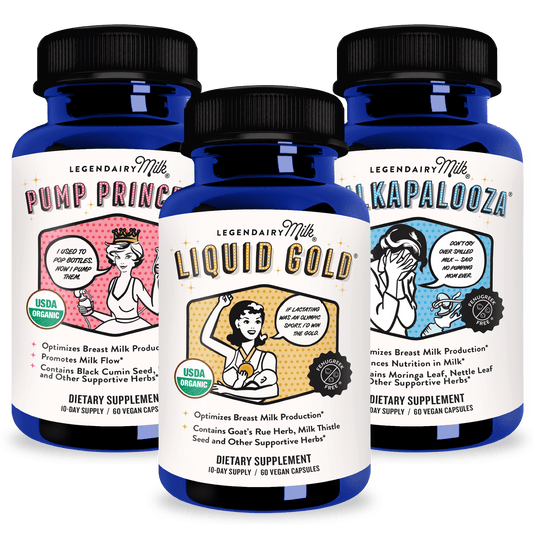
Lactation supplements: If you are working through a sensitive supply or a dip related to birth recovery, blood loss, or early separation, Legendairy Milk’s galactagogue blends can be part of your plan alongside frequent milk removal and skilled lactation support.
Hydration: Pair your morning or middle-of-the-night feeds with She’s Thirsty™ so you actually drink electrolytes instead of just refilling the same water cup.
Prenatal vitamins while breastfeeding: Many providers recommend continuing a prenatal or a well-designed postnatal multivitamin while breastfeeding to help cover increased nutrient needs, especially when your eating is chaotic. (10,11,12) A product like Dynamic Duo® Prenatal can help fill gaps as you recover and lactate.
Habit stack example: “Every time I sit down for the 2 a.m. feed, I mix She’s Thirsty™, take my prenatal, and hit play on a comfort show.”
Feeds often become more efficient in this window. You may notice:
Baby finishing feeds faster
Some longer stretches between feeds or at night
Growth spurts that temporarily ramp feeding back up
Returning to work and adding pumping
More distraction at the breast as baby becomes alert and curious
The American Academy of Pediatrics recommends exclusive breastfeeding for about the first 6 months, if possible, before solids are added. (1)
Night feeds still matter. Prolactin remains higher overnight, and removing milk during those hours helps maintain supply. (8,9,13)
By this stage, your milk is considered “mature,” but it is still dynamic. Large studies show gradual shifts in fat and protein and continued delivery of bioactive components, including oligosaccharides, hormones, and antibodies. (3,4,15)
Your breast milk volume and composition adapt to how often and how effectively milk is removed.
As life gets busier, your own needs can fall to the bottom of the list.
Milk output and pumping: If you are pumping to build a stash or to cover work hours, lactation supplements can be used strategically to support output while you focus on fit, flange size, and pumping schedule.
Hair and skin changes: Around 3 to 4 months, postpartum hair shedding tends to kick in as hormone levels shift. A hair health formula like Mane Event™ can be a small way to support yourself nutritionally while you ride out that phase.
Mood and stress support: If you are feeling wired, tired, and overwhelmed, talk with your provider about support options. For some parents, a supplement like Miss Bliss™ becomes part of an evening wind-down ritual, alongside therapy, social support, or medication where appropriate.
Habit stack example: “When I hook up to the pump at work, I start my pump session checklist, take a Legendairy Milk lactation supplement if I am using one, and drink a full bottle with She’s Thirsty™.”
Around 6 months, most babies begin solid foods, though breast milk or formula remains their primary source of nutrition for the first year. (2,16)
You might see:
Messy high chair experiments
Teething and occasional biting
Distracted daytime feeds and more reverse cycling at night
Rolling, crawling, pulling up, and then face-planting into your chest for comfort
Talk about “sleeping through the night,” which may or may not fit your reality
Breastfeeding through these transitions is still normal and beneficial. Night feeds can remain important both for nutrition and for supply, and for many families they are woven into attachment and soothing. (13,14)
Some parents begin to consider night weaning in this window. Gradual changes and protecting some milk removal overnight can help reduce the impact on supply.
Even with solids on board, breast milk continues to provide significant energy, fat, and immune protection. Studies of prolonged lactation find that, in the second year of life, breast milk often has higher fat and energy content, which makes sense for toddlers who nurse less often but are more active. (5,6)
Your milk composition responds to your child’s needs, whether that is a growth spurt, a busy developmental leap, or a week of daycare colds.
This is a good season to widen the lens from “just milk supply” to whole-body support.
Gut and skin: A daily collagen and fiber drink like She’s Glowing™ can support postpartum skin elasticity and gut comfort while you chase a mobile baby.
Hydration habits: Keeping She’s Thirsty™ at your usual feeding or pumping spots makes it easier to actually hydrate during a day that feels like a sprint.
Continuing prenatals: Many experts support using a prenatal or targeted postnatal supplement throughout lactation. (10,11,17)
Habit stack example: “After dinner, while my baby has solids, I mix She’s Glowing™ for myself and take my prenatal. When I nurse before bed, I drink water with She’s Thirsty™.”
Between one and two years, breastfeeding often shifts into a new role.
You may notice:
Nursing mainly upon waking, before naps, and at bedtime
“Drive-by” comfort feeds during big feelings or transitions
Nursing as reconnection after daycare or time apart
More conversations about weaning, from you or from relatives
Sleep changes, from finally getting longer stretches to sleep regressions
The AAP and WHO both support continued breastfeeding for 2 years or beyond, as long as it is mutually desired. (1,2) There is no medical requirement to wean at one year-or two years- if breastfeeding is working for you.
Research on milk in the second year shows:
Macronutrients remain adequate, and fat content often rises
Immune factors continue to be present, which can matter in the toddler “constant sniffles” phase
The overall volume of milk usually decreases as solid intake rises, but nursing still contributes energy and comfort (5,6,18)
Your breast milk is now part food, part immune support, part regulation tool for a small person with very big feelings.
Some mothers see their period return around 6 to 12 weeks postpartum, especially with less frequent breastfeeding. Others do not see a cycle for a year or more. This period of suppressed or irregular cycles is called lactational amenorrhea and is driven by prolactin’s effect on the hormones that trigger ovulation. (19,20)
The timing of cycle return depends on how often the baby nurses, whether nights are spaced out, and individual biology. (19,21)
If you are thinking about spacing children or trying to conceive again, it can help to:
Track your cycles once they return
Talk with your provider about contraception, fertility awareness, or preconception care
Support your own nutrient needs with a prenatal or women’s health supplement tailored to your situation
Legendairy Milk’s Dynamic Duo® Prenatal, Myo & D-Chiro Inositol, and other women’s health products can become part of that transition as you move from “fourth trimester” into the next chapter.
Some families fully wean between one and two years. Others continue nursing beyond two. Many do a gradual version of “don’t offer, don’t refuse,” or keep a few favorite feeds and phase out others.
Whatever you choose, it is normal for weaning to stir up big feelings, both for you and your child. Nursing has been a hormone-fueled, skin-to-skin, around-the-clock relationship. Your body and brain notice when it shifts.
A few supports in this stage:
Hydration and gentle movement to help with any engorgement
Mood support that can include therapy, community, and, when appropriate, tools like Miss Bliss™ for stress and emotional balance
Hair, skin, and gut support with Mane Event™ and She’s Glowing™ as you move further from the immediate postpartum window
You are allowed to grieve the end of a breastfeeding chapter and still feel ready to close it.
Legendairy Milk started with lactation supplements, but the goal has always been bigger than simply “make more milk.” We are here to support the full spectrum of modern motherhood:
Lactation support when you are building or protecting supply
Hydration and gut support with She’s Thirsty® and She’s Glowing™ as your days get fuller
Nutritional foundations with prenatal and women’s health products while you are breastfeeding, weaning, or planning another pregnancy
Hair and mood support with Mane Event™ and Miss Bliss™ as your body and nervous system adapt to each new stage
Your breast milk will change again and again in the first two years. Your baby will, too. So will you.
There is no one right way to walk this path. What matters is that you feel supported, informed, and respected as the expert on your own body and baby. Legendairy Milk is here to be one piece of that support, whether you are nursing a newborn around the clock, tandem feeding a toddler and a newborn, or closing the breastfeeding chapter and stepping into the next part of your story.
You and your milk have already done something extraordinary. You deserve tools and habits that make you feel held in the process.
American Academy of Pediatrics. Breastfeeding: AAP Policy Explained. HealthyChildren.org. 2024. https://www.healthychildren.org/English/ages-stages/baby/breastfeeding/Pages/Where-We-Stand-Breastfeeding.aspx
World Health Organization. Continued breastfeeding for healthy growth and development of children. 2013. https://www.who.int/tools/elena/commentary/continued-breastfeeding
Ballard O, Morrow AL. Human milk composition: nutrients and bioactive factors. Pediatr Clin North Am. 2013;60(1):49–74. https://www.ncbi.nlm.nih.gov/pmc/articles/PMC3586783/
Pham Q, et al. Factors affecting the composition of expressed fresh human milk. Breastfeed Med. 2020;15(9):1–8.https://journals.sagepub.com/doi/10.1089/bfm.2020.0195
Czosnykowska-Łukacka M, et al. Breast milk macronutrient components in prolonged lactation. Nutrients. 2018;10(12):1893. https://www.ncbi.nlm.nih.gov/pmc/articles/PMC6316538/
Muts J, et al. Macronutrient concentrations in human milk beyond the first year of lactation. Arch Dis Child Fetal Neonatal Ed. 2025;110(3):248–254.
Trafton A. Study reveals the dynamics of human milk production. MIT News. 2022. https://news.mit.edu/2022/study-reveals-dynamics-human-milk-production-0405
Kim YJ, et al. Pivotal roles of prolactin and other hormones in lactogenesis and lactation. Ann Pediatr Endocrinol Metab. 2020;25(2):80–88.https://www.ncbi.nlm.nih.gov/pmc/articles/PMC7402985/
La Leche League GB. Breastfeeding at night. 2020. Available at: https://laleche.org.uk/breastfeeding-at-night/
American Pregnancy Association. Postnatal Vitamins While Breastfeeding. Available at: https://americanpregnancy.org/healthy-pregnancy/breastfeeding/postnatal-vitamins-while-breastfeeding/
Centers for Disease Control and Prevention. Maternal Diet and Breastfeeding. 2025. https://www.cdc.gov/breastfeeding-special-circumstances/hcp/diet-micronutrients/maternal-diet.html
La Leche League International. Vitamins and Other Nutritional Supplements for Baby and Mother. https://llli.org/breastfeeding-info/vitamins-nutritional-supplements/
Aeroflow Breastpumps. Having a Strong Breastfeeding Relationship at Night. 2024. https://aeroflowbreastpumps.com/care-guides/post/having-a-strong-breastfeeding-relationship-at-night
MilkWorks. Sleeping Through the Night handout. 2024. https://milkworks.org/file_download/inline/376bae58-c87f-42a7-a5e0-05fe26c23edc
Thum C, et al. Changes in human milk fat globule composition throughout lactation. Front Nutr. 2022;9:835856. https://www.frontiersin.org/articles/10.3389/fnut.2022.835856/full
Boland M. Exclusive breastfeeding should continue to six months. Paediatr Child Health. 2005;10(3):148–150. https://www.ncbi.nlm.nih.gov/pmc/articles/PMC2722513/
Fourth Trimester Foundations. Should I Keep Taking a Prenatal Vitamin Postpartum. 2024.https://www.fourthtrimesterfoundations.com/blog/newborns-are-weird-jbb8g-ph7bk
The Lactation Network. The Benefits of Breastfeeding: A Timeline for the Ages. 2024. https://lactationnetwork.com/blog/the-benefits-of-breastfeeding-a-timeline-for-the-ages/
La Leche League International. Lactational amenorrhea, fertility, birth control and breastfeeding. 2022. https://llli.org/news/lactational-amenorrhea-fertility-birth-control-and-breastfeeding/
Mamata Fertility. Irregular Periods During Breastfeeding: Causes, Symptoms, and When to Seek Help. 2025. https://mamatafertility.com/blog/irregular-periods-during-breastfeeding-causes-symptoms-when-to-seek-help/
Chao S, et al. The effect of lactation on ovulation and fertility. Clin Obstet Gynecol. 1987;30(3):573–580. https://pubmed.ncbi.nlm.nih.gov/3549114/
Shop this Blog
She’s Thirsty® Coconut Water Electrolyte Mix
$29.99